Most UNIX-derived systems actually suck.
There are two (well, three-ish) popular designs for an operating system:
- the DOS way: windows, DOS operating systems
- the UNIX way: linux systems, macOS, BSD, IRIX, …
The DOS way used to not suck as much… but since the introduction of Windows it sucks. It sucks really badly.
UNIX
UNIX was the result of Dennis Ritchie († RIP), Ken Thrompson, and others at AT&T’s frustration with the ambitious, complex, and ultimately unsuccessful MULTICS.
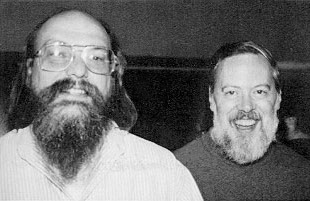
Reserarch UNIX introduced lots of things to the paradigm of OSes:
- a hierarchical file system with then new idea of directories, now often known as folders.
- processes and a pretty simple process model: executed programs became processes that could easily be manipulated
- pipes; an OS construct that joins the output of a program to the input of another
- the UNIX philosophy: make programs do one thing, and do it right
- C: the language that makes the world go around, it made the whole thing thousands of times more portable
- a coherent programing interface; files, devices, processes, signals, and syscalls are small and elegant concepts you can learn easier than the circus of other OSes at the time.
The UNIX philosophy made all of this coherent; the term refers to the guidelines written in the 1974 UNIX paper:
- make twelve programs that each do one thing and do it well rather than one program that does 12 things half-right
- make programs that work together
- make programs that deal with text streams, since that’s an universal interface
- everything is a file (the Plan 9 operating system takes this to the absolute extreme)
- worse is better (or “New Jersey style”)
Derivants
It’s not 1982 any more; the original UNIX—for practical use—is pretty useless. It’s fun as a recreational computing artifact, but nobody makes software for UNIX anymore.
But luckily, we’ve got a couple thousand derivants that keep the design intact, right? Well, the first part is true, there is a myriad of OSes similar to UNIX, unoriginally named UNIX-like operating systems. The second part is not.
macOS is the most used UNIX-like [desktop, of course there is Android; which is mostly a linux distribution with the heck of a bunch of modifications tbh] operating system, it’s developed proprietary by Apple and is full of absolute bloat. Let’s take the second most used: Linux.
Linux
(GNU/)Linux is better than macOS, that does not mean Linux is good. Modern Linux is the polar opposite of the UNIX philosophy; your average Linux desktop looks like this:
- The Linux kernel. Actually, there is no such thing as the Linux OS, Linux is a 40-million (probably more; this measure was taken on Linux 6.14 rc1, on 2025) monolithic kernel.
- GNU coreutils: an aberration of utilities coded by the GNU project; a collective that enshittifies everything they touch.
- GNU C Compiler (GCC): a 15 million LOC (as of a 2019 measuring) C compiler that has single-handedly ruined all compatibility with a million GNU-isms
- GNU lib C (glibc): a C standard library (libc), that has monopolized the C industry; try building a system with musl that your average Linux user would use
- X11: a confusing, flawed, massive, badly-designed display system with weird protocols
- Or wlroots: A library implementing the wayland protocol and the heck of bunch of extra protocols
- GNOME: a collection of shitty programs all based on the GTK framework, making a roughly usable desktop system for users
There are better linux distributions. For example, Void Linux XFCE musl edition is a much, much lighter and still usable desktop, using the musl libc and runit init system, but software compatibility is rough nevertheless; Linux is scarsely supported by big companies, and musl lacks support for many interfaces programs expect. Void also features the xbps (X Binary Package System), a GREAT package manager, and xbps-src, which acts as a ports system, I use Void Linux as my daily driver myself. Chimera linux is also really good, as well as Alpine, credit where credit is due.
BSD
BSD is a whole other breed of operating systems. It bear with the original Berkely Software Distribution, made in the Berkeley university of California, by Bill Joy mostly, the creator of vi too. It was originally based in UNIX but after a long legal battle between the university and AT&T, all of the AT&T code was removed on 1991, on version Net/2.
To post a comment you need to login first.